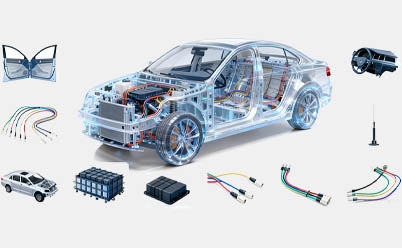

Full View of Automotive Wiring Harnesses
Applicable Components: Engine wiring harness, instrument panel wiring harness, chassis wiring harness, door wiring harness, antenna wiring harness, headlight wiring harness, etc.
Customer Pain Points: Ability to provide various wiring harness requirements, combining reliability and durability, high assembly efficiency and adaptability, compliance certification, and low material costs.
Solutions:
Engine Wiring Harness – Uses PTFE or silicone rubber materials resistant to temperatures above 200℃, reducing aging rate by 70% and achieving 80% heat insulation efficiency; adopts IP6K9K level sealing design for upgraded sealing and protection; uses copper mesh braiding; real-time monitoring of wiring harness temperature and current anomalies provides early warning of faults.
Instrument Panel Wiring Harness – Uses double-layer shielding with aluminum foil and copper mesh, achieving a shielding efficiency of over 95%; selects high-purity oxygen-free copper wire (purity ≥99.99%), reducing signal transmission loss by 40%; pre-fixed and interference-avoided before leaving the factory; uses low-temperature resistant TPE material and is coated with an anti-UV coating.
Chassis Wiring Harness – Uses a combination of metal brackets and elastic buffer pads. Double-fixed structure; uses multi-strand ultra-fine copper wire twisted conductors; the entire harness adopts IP6K9K level sealing design; the harness layout adopts a “high-traffic path”, and deflectors are added to key parts.
Door harness—the harness at the door hinge is equipped with a “corrugated tube + spring protective sleeve” combination structure, increasing tensile strength by 80%; a waterproof plug is added to the entrance of the door harness.
Antenna harness—uses ultra-fine coaxial cable, the shielding layer adopts a “double-layer tinned copper mesh + aluminum foil” structure, increasing signal transmission rate by 25%; electromagnetic isolation and shielding use high and low temperature resistant, UV resistant TPU material, the harness surface is sprayed with an anti-corrosion coating, extending service life to 8-10 years.
Headlight harness—adopts high-load conductors and insulation design to reduce safety risks; the signal line adopts a twisted pair structure; the harness adopts a “metal bracket + silicone buffer pad” double fixation, reducing harness vibration amplitude by 90%.
Results: The failure rate of the car in extreme environments is reduced by 80%; the mechanical damage rate is reduced. 70%; assembly time reduced, production line capacity increased by 30%, and maintenance costs reduced by 60%; signal shielding efficiency reached over 95%, and overload tolerance improved; compliance met.